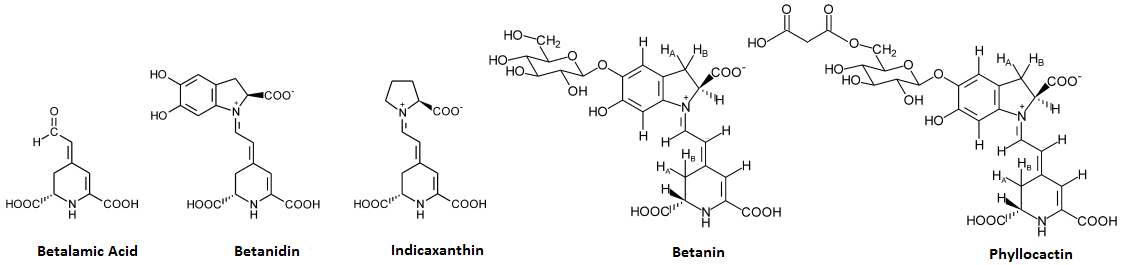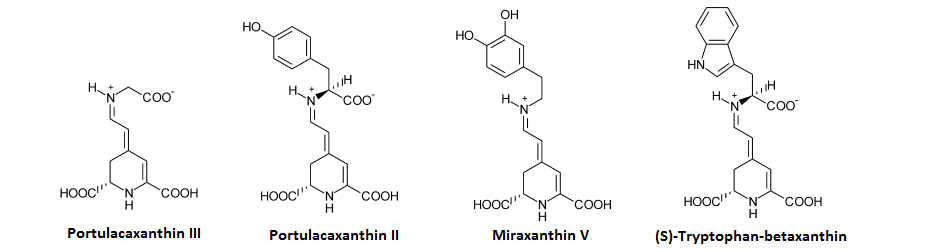
Betalains are nitrogen containing pigments found in a variety of foods that are reddish in hue, and occur in red plants that do not contain anthocyanin molecules as the red pigment (ie. beet root contains betalains, whereas strawberries contains anthocyanins such as pelargonidin for their reddish hue).[1] They are at times used for food coloration in products such as ice cream, candies, and processed meat[1][2] and the quantity in these foods rarely exceeds 50mg/kg due to their strong pigment coloration[3] stronger even than red radish anthocyanins.[4] Betalains in general as a food colorant, since they almost exclusively come from beets, are usually referred to as 'beetroot red' and are considered a natural food colorant.[2]
The majority of plants containing betalains are in the caryophyllales family with exception to the caryophyllaceae and molluginaceae genera, which accumulate anthocyanins for their red coloration.[5]
Betalains are reddish-purple pigments that are found in some plants when anthocyanins are nor present as pigmentation
Common dietary sources of betalains include:
- Beet root products (Beta vulgaris subspecies vulgaris)[6] with the content in red beets ranging from 0.02-0.21% depending on cultivar[2] with the major red components being betanidin and betanin (as well as their isomers) while the major yellow components are vulgaxanthin I and vulgaxanthin II[7]
- Colored swiss chard (Beta vulgaris subspecies cicla)[8]
- Amaranth (Amaranthus genus)[9]
- Cactus fruits (Opuntia and hylocereus genera)[6][10] and pitahaya (Hylocereus)[11]