Devil's Claw (Harpagophytum procumbens of the family Pedaliaceae) is an African herb that can be found in Namibia, Botswana, South Africa, Angola, Zambia, and Zimbabwe; traditional usage of Devil's Claw is as an analgesic, for fevers and allergies, appetite stimulation, wounds and skin rashes, dyspepsia, liver and kidney disorders, as diuretic and sedative, and to treat degenerative disorders of the musculoskeletal system[1][2] The dried tubers tend to be the active part of the plant used (specifically the secondary tubers, those that branch off the main stems),[3] despite the name of Devil's Claw being drawn from the fruits; the fruits of Harpagophytum procumbens tend to have two straight thorns and numerous characteristically long protrusions with sharp, grapple-like hooks.[3] Other names for this plant, Grapple plant and Duiwelsklou, also refer to these claw-like protrusions and the species name (Harpagophytum) is derived from Harpago, the Greek term for the grappling hook.[3] Some other names include Wood Spider.[4]
The herb Harpagophytum zeyheri is also sometimes referred to as Devil's Claw,[3] although it is lower in bioactives and is commonly seen as an adulterant.[5] The presence of the molecule known as 6-acetylacteoside can be used to detect the species, as it is present in Procumbens but absent in Zeyheri as can the ratio of 8-O-p-coumaroylharpagide to the sum of Harpagoside as it is below 10% in Procumbens yet higher than 31% in Zeyheri.[6]
Harpagophytum procumbens can be further divided into two subspecies; H. procumbens subsp. procumbens or H. procumbens subsp. transvaalense.[3]
Devil's Claw is a name given to the plant Harpagophytum procumbens due to the appearance of claws on the fruits; the storage form of the plant, the tubers, are used medicinally while the name is due to the fruits which are not used medicinally
Composition
Devil's Claw contains:
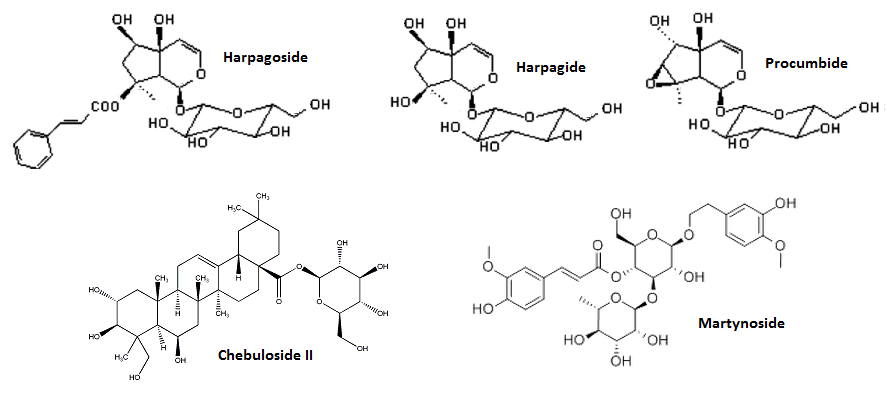
- The simple Irioid Glycosides known as Harpagide and Procumbide[2]
- Derivatives of Harpagide including Harpagoside (also known as 8-cinnamoylharpagide), 8-cinnamoylmyoporoside, 8-O-feruloylharpagide (1% of commercial extracts, 0.25% dry plant weight[7]), and (same glycoside) as well as Harprocumbide A and 6-O-alpha-D-galactopyranosylharpagoside (different glycosides)[2] and Pagide[8]
- 8-O-(p-coumaroyl)-harpagide and 8-O-(cis-p-coumaroyl)-harpagide, built off Harpagide and both referred to by the acronym of 8-PCHG[2][3]
- Derivatives of Procumbide including harprocumbide B and 6"-O-(p-coumaroyl)-procumbide[2]
- Pagoside[9] and Methoxypagoside[10]
- Decaffeoylverbascoside[10]
- Pentacyclic saponins Nigaichigoside F1 and F2,[2][11] Chebuloside II,[2][11] and Harproside[8]
- Phenolic/Phenylethanoid Glycosides such as Acteoside[12] (also known as Verbascoside, the main Phenylethanoid Glycoside[13] at up to 15.8% of ethanolic extracts or 2% plant dry weight[7]) and Isoacteoside (5% ethanolic extract[7]),[14] as well as 6-acetylacteoside, 6'-O-acetylacteoside (10% ethanolic extract[7]), 2'-O-Acetylacetoside (2% ethanolic extract[7]) 2,6-diacetylacteoside (3% ethanolic extract[7]),[15] Martynoside,[2][11] [16] Leucosceptoside A and β-OH-verbascoside[17]
- β-(3′,4′-dihydroxyphenyl)-O-α-rhamnopyranosyl(1→3)-β-d-glucopyranoside[14]
- (+)-8,11,13-totaratriene-12,13-diol (built off of a totarane structure)[7][18]
- (+)-8,11,13-abietatrien-12-ol (Ferruginol, built off of an abietane structure)[7][18] and 13-hydroxytotara-7,9,13-trien-6,12-dione (Maytenoquinone)[7]
- Chinane-type tricyclic diterpenoids,[19] which have been noted to form a Diels-Adder product[7]
- Cinnamic acid and Caffeic Acid[7][9]
- 7α-hydroxysitosterol and 7β-hydroxysitosterol
When looking at Harpagoside, which is commonly seen as the molecule to assess for standardization and a biomarker of the medicinally efficacy of the plant, the secondary tubers appear to have twice as much Harpagoside as the primary tubers;[3] the flowers, fruits, and stems are seemingly absent while leaves have trace amounts.[3] The tubers tend to contain anywhere between 0.5-3% Irioid Glycosides (the class seen as bioactive)[20]
The active ingredient(s) is/are not fully established, but Harpagoside is commonly referred to as the active ingredient since products with Harpagoside are the same products with therapeutic efficacy. Due to this, Harpagoside is a marker of efficacy and is usually standardized to above 1.2% total weight
The phenylethanoid glycosides are most likely contributors to the therapeutic effects, since they are found in high quantities in the ethanolic extracts (commonly used for anti-inflammatory purposes) and have anti-inflammatory effects in isolation