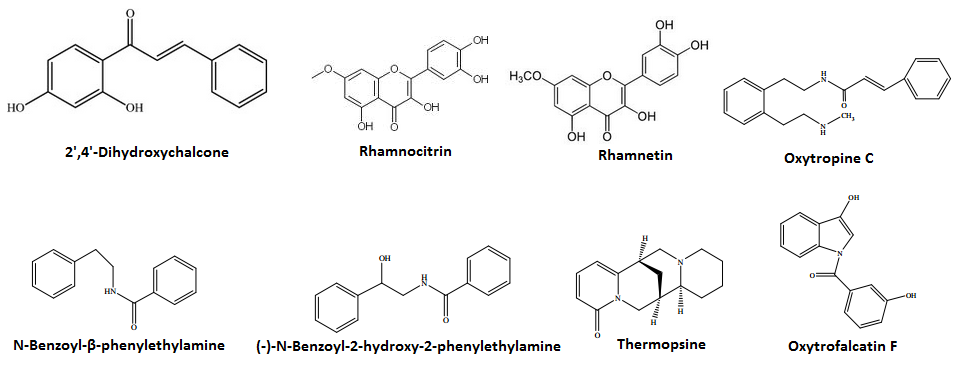
Oxytropis falcate (of the family Leguminosae) is a herb used in Traditional Chinese Medicine where it has the name 'Edaxia' and used to treat inflammation, influenza, pain, bleeding and anthrax. It has been used in Tibetan medicine, where it is called “King of Herbs” and one of the “Three Anti-inflammatory Drug”.[1][2] It commonly grows in high altitudes (2700–4300m above sea level) in North Eastern and Southern Western China and due to this tends to grow mostly in either the Himilayas or at the Qinghai-Tibet Plateau.[3] Traditional usage of Oxytropis Falcate, usually in Tibet, suggests that spraying the dried powder of the roots over wounds accelerates healing and provides pain relief.[3]
The term 'Locoweed' is used to refer to plants of the Oxytropis family (although some plants of the Astragalus family also get included[4] and sometimes Swainsonia also gets called Locoweed[5]). These three genera all get called Locoweed due to having similar social renown, since the bioactive Swainsonine that is found in all genera (not yet identified in the species of Oxytropus known as Falcate but is present in ochrocephala[4]) can inhibit lysosomal α-mannosidase and mannosidase II enzymes and kill livestock that forage on 'Locoweeds'.[6][7][8]
Some studies also refer to similar historical usage when referring to an Oxytropus Falcata, suggesting the two species names are used interchangeably.[1]
A highly acclaimed herb for Tibetan medicine (King of Tibetan Medicine like Ganoderma Lucidum is to Chinese and Ashawgandha is to Indian). A species in the Oxytropus genera appears to be highly toxic to livestock that graze upon it