Overview
Testosterone is a hormone produced primarily in the testes in men and the ovaries in women. Testosterone is connected to sexual development, muscle building, fat loss, some aspects of cognition, and hair loss.[1]
Your testosterone levels may not tell the whole story of how testosterone is functioning in your body. Total testosterone can be divided into three categories.[2]
- Tightly bound testosterone: About two-thirds of the testosterone in your blood is bound to sex hormone binding globulin (SHBG). It is not readily available for use by your body.
- Loosely bound testosterone: About one-third of the testosterone in your blood is weakly bound to albumin. Once the bond is broken, the testosterone circulates as free testosterone in your body.
- Free testosterone: A small percentage of the testosterone in your blood (1–4%, as a rule) floats around freely. Your body can readily use it, and the enzyme 5-alpha-reductase can convert it to dihydrotestosterone (DHT), a very potent androgen.
Together, your loosely bound and free testosterone compose your bioavailable testosterone, which has a greater impact on your health than your total testosterone.
How are testosterone levels assessed?
A blood test is used to assess testosterone and its components (free T, bound T, etc). Abnormally low or high levels can cause health issues in males and females.
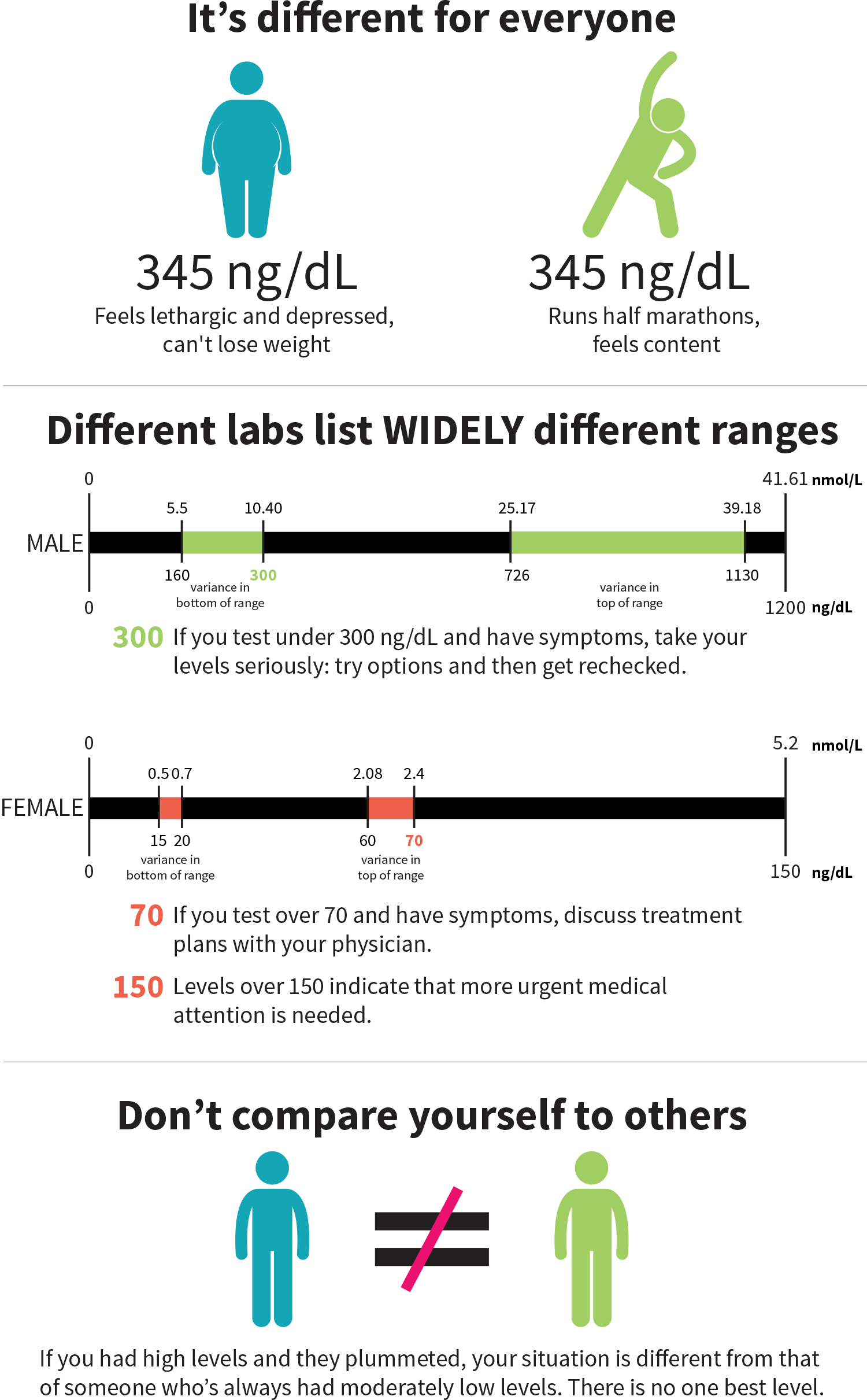
When your T levels are tested, the reference range can vary a lot from lab to lab. A recent study showed that the bottom of the range for males can be 5.55–10.4 nanomoles per liter, or nmol/L (160–300 nanograms per deciliter, or ng/dL), and the top of the range can be 25.17–39.18 nmol/L (726–1,130 ng/dL).[3] So if you get measured at 280 ng/dL, you may or may not be considered as having “low testosterone”.[3]
Because testosterone levels can fluctuate throughout the day, the test should be performed in the morning (8–11 a.m.). If the results come back low, a second test can be ordered to confirm the first result. As part of the workup, your physician may also measure your levels of luteinizing hormone (LH), follicle-stimulating hormone (FSH), and the T4 thyroid hormone (thyroxine) to get an accurate diagnosis.
Assessing testosterone levels